This week, I was really struck by the idea of re-examining published information, especially self-published information. In both Ursula K. Le Guin’s “Is Gender Necessary? Redux” (1976/1987) and Anne Fausto-Sterling’s “The Five Sexes, Revisited” (2000), the authors return to their previous works to re-evaluate their conclusions in a modern context. Le Guin directly revises her text using parenthetical statements, which allow the reader to compare her 1976 arguments to her 1987 corrections. I really respected her willingness to acknowledge critiques of her work and admit where she was wrong. In particular, she listened to criticism on pronouns for Gethenians and removed “he” series pronouns from her text. She also recognized the heteronormativity of her novel.
It doesn’t seem right or wise to revise an old text severely, as if trying to obliterate it, hiding the evidence that one had to go there to get here. It is rather in the feminist mode to let one’s changes of mind, and the processes of change, stand as evidence — and perhaps to remind people that minds that don’t change are like clams that don’t open.
“Is Gender Necessary? Redux” by Ursula K. Le Guin
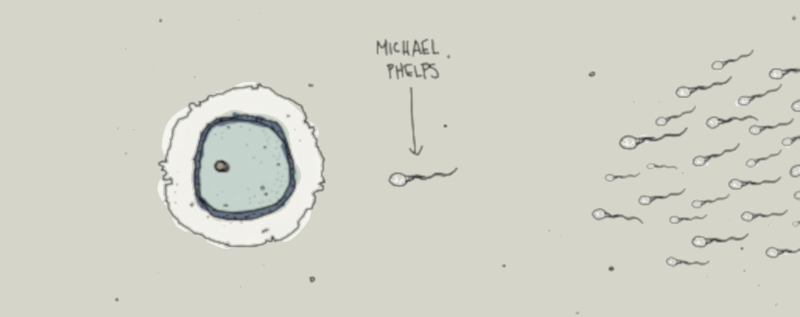
Along a similar vein, in Emily Martin’s “The Egg and the Sperm: How Science Has Constructed a Romance Based on Stereotypical Male-Female Roles” (1991), the author questions long established narratives of human reproduction. While science may seem absolute and objective, Martin points out that the biases of the scientists may influence the conclusions they draw. I’m curious what other seemingly established facts are actually distorted by societal conventions.
 Feminist Science Fictions